Category Archives: acoustic

The Company Says

The Company Says


I‘ve never been a union member — I don’t really think I’d be a good fit. I have worked (in non-union jobs) in a union environment (though it was a Teamsters shop in the ’70s… not exactly the best showcase for the postive aspects of trade unionism).

I understand the collective bargaining system and — though it is clearly far from perfect and may not be well-suited to modern, progressive companies — I think over the last century and change that it has, on balance, worked fairly well for both US workers and companies, bringing some much needed stability to employment relations at the end of the 19th century and laying the foundation for the 20th century American middle class, which, itself, nurtured the enormous expansion of US manufacturing in the last century.

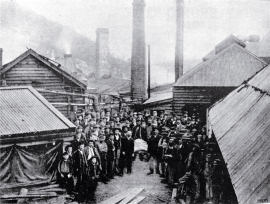
But at the dawn of the union era, it was a different matter. Around the globe, workers in the industrializing nations of Europe and North America faced unsafe working conditions and violence and intimidation from privately held companies. While stockholders might blanch at the thought of company-hired goons firing what we now call “live rounds” into crowds of workers and splitting heads with metal clubs, individual mine and factory owners all too often didn’t.

It’s a different time, now, of course.

But only a few days ago with the Sago mine disaster/debacle, we had a grim reminder that even modern, publicly held companies can fall down and fall down hard when it comes to treating their workers with common decency and regard for their safety and health.

And the part of our federal government devoted to policing those conditions fell down hard, as well, handing out scores of hazard violation citations — but backing them up with trifling punishment. In one case — at a Sago mine — the company was cited for “significant and substantial” violations and ongoing dangerous conditions that led to the death of miner — and then fined the minimum possible — $60.

Maybe we haven’t evolved beyond the need for unions, after all…

The Company Says

You walk into town
and you look all around
and it doesn’t take long
to see that something is wrong
very wrong

the people stand around
with their eyes on the ground
it doesn’t take long
to see that something is wrong

and the company says
it’s a company town
now, if you don’t like that
don’t ya hang around

and the Company says
it’s a company town
if you don’t like that
sell a penny on the pound
give ‘way

One man stands
says I won’t run
but the goons come around
with their clubs and guns

and they knock him down
and they kick him around
and they drag his body
to the edge of town

and the company says
he’s better off dead
than fightin’ with us

and the company says
it’s a company town
if you don’t like that
we’ll put you in the ground

and the Company says
it’s a company town
now, if you don’t like that
don’t ya hang around

and the Company says
it’s a company town
if you don’t like that
sell a penny on the pound
give ‘way

and the company says
he’s better off dead
than fightin’ with us

and the company says
it’s a company town
if you don’t like that
we’ll put you in the ground

(C)1986, TK Major

Share

I Saw My Baby on the Street Today

I Saw My Baby on the Street Today

You see a lot of homeless people near the ocean, at least around here.

If you ask them, often as not they’ll tell you, if you have to be homeless somewhere, you might as well be homeless by the beach. And there are often pick-up jobs and day labor opportunities near the waterfront, and sometimes hideaways in coastal estuaries.

But sometimes I can’t help wondering — as I’m sure others have wondered — whether they end up along the water because other people keep pushing them away and, eventually, there’s just nowhere else to go.

The protagonist of this song finds himself torn between pity and forgotten love as he struggles with the natural inclination to turn away when he sees his estranged wife homeless on the street and she doesn’t recognize him.

I’ve seen the mutation and destruction of personality that can result from some sickness and injury and I don’t know that I would have the kind of selflessness it takes to make the sacrifice he makes by eventually taking her back in. (Eventually, meaning by the second short verse in a two verse song.)

I saw my baby on the street today

I saw my baby on the street today
she didn’t recognize me I turned away
I shoulda said
come back baby
come back home
how could I leave ya out here all alone(in the cold

I know youre crazy
and it’s tearing me apart
but I vowed to love you
til’ death do us part

come back baby come back home
i jusc can lveave you out there in the cold
unpack your shopping crat
take a nice long bath
it ain’t like the old days
but the worst is past

I know youre crazy
and it’s tearing me apart
but I vowed to love you
til’ death do us part

(C)1990, TK Major

Share

Download Cheater’s Blues

Download Cheater's Blues

Once upon a time there was a magical kingdom, ruled by a magical king.

The king had himself once been a knight errant but through his adventures he’d earned a small fortune — more importantly, he’d learned magical powers from the wizards of the east.

In those days, the most powerful magic in the in the land was so potent, it was known by just three letters — IPO. Even today, though the magic has faded, those letters are still very powerful.

But, in those days, the magic of the IPO was everywhere.

And most notably in the magic kingdom founded by the wandering knight. Through the magic of IPO, the knight was able to raise almost a half billion pieces of gold. (In our time, that would buy 33 thousand Toyota Corollas, fully equipped with factory air and power windows and locks.)

But the magic of the IPO required that the kingdom appear to be a happy and prosperous kingdom — so the king decided to give money to his citizens every time someone heard one of their songs. (Did we mention this was a kingdom of musicians? Weird, huh?) The king called it Pay for Play… PfP.

As one might imagine, this was greeted with great joy by the citizens of the kingdom. Most of them had never received a single shekel for their music and never expected to.

But with great good fortune, sometimes comes danger. And in the magic kingdom, this danger showed the face of greed. Soon, the musician citizens were learning devious magic of their own, pretending to listen to each others music, and pocketing the money.

The king seemed oblivious to the trouble in his streets. But he must have realized that, in a kingdom of musicians, there could only be so many people listening at a time — for he tried various means to lure travelers in to hear his musicians.

One of the lures was in the form of big lists of the most popular songs, which he called “charts.”

Soon, the biggest cheaters in the land were at the top of the charts, based on music that no one really heard. And sometimes the greedy musicians were also magicians and they plied the devious tactics of their trade, esoteric magic like IP Masking. They even used soulless robots to listen to music for them…

But a few musicians in the magic kingdom raised their voices in protest [that’s where today’s song comes in. —TK] , calling out for their fellow musicians to eschew greed and trickery… to do the right thing and to stop tricking the king and working the evil magic that kept the banal and vapid music of IT wizards at the top of the charts.

But it was already too late.

Unknown to all but those who were conversant in the esoteric writings of The Business Section, a strange and terrible new magic was eating at the very foundation of the magic kingdom…

And it was this strange and terrible magic which brought down the magic king, who was forced to sell the magic kingdom for little more than a song to one of the old kingdoms once known as The Seven Sisters. But that’s a story for another time…

[I’d like to acknowledge that the story above is hardly the first fairy tale telling of the rise and fall of a rags-to-riches-to-rags internet/IPO story — probably not even the first to apply such a format to the story of the not-quite-named startup above. BTW, all that remains of that once-high-flying company is its dot com nameplate, now simply a portal for commercial music promotion.]

Download Cheater’s Blues

Spent all night on the DSL
downloading music straight to hell
I got the PfP
Download cheater’s blues

I’ll download your page you stream mine
Neither one listen that’ll be just fine
I got the PfP
Download cheater’s blues

I used to play music now I just swap downloads
cause sharpenin’ my chops is too darn slow
I got the PfP
Download cheater’s blues
I use to play music now download swappin’s all I do

Didn’t I see you
on the bulletin board
You were waving your T1
and lookin’ to score
You had the PfP
Download cheater’s blues

Y’ offered two whole pages
for just one song
you seemed kind of desperate
seemed like something was wrong
You had the PfP
Download cheater’s blues

You said I.S. was on your trail
they were sniffin your packets
like a hound after quail
You got the PfP
Download cheater’s blues
And you thought chart position
was the only thing that you had to lose.

[bridge]
I used to write songs I don’t do that no more
Now I spend all my time on the bulletin boards
With crazy vampires, psychos and more
just swappin those downloads and bumpin the score
I used to love music and I listened all day
Now I ripped out my speakers and threw them away
Cause there’s swappin to do and there’s stations to play
I got 5000 songs to download to day

Spent all night on the DSL
downloadin music straight to hell
I got the PfP
Download cheater’s blues
I’ll download your page you stream mine
Neither one listen that’ll be just fine
I got the PfP
Download cheater’s blues

(C)2000 TK Major

Share

Mountains Come, Mountains Go

Mountains Come, Mountains Go


In 1999, I collaborated over the ‘net with an English techno kid named Deakin Scott. He’d heard my trip hop stuff on the old mp3.com and he asked if I wanted to write a vocal part for a 140 beat per minute mix he was working on.

He emailed me a work mix as a guide. I listened over and over, playing with different ideas. Finally, in frustration, I picked up my acoustic guitar and started hashing out some classic rock and roll chords, unrelated to Deakin’s music.

There was, in that first exploration, a kind of teen angel sort of vibe and when I surrendered to that vibe, the lyrics below pretty much came out whole. They play off the teen tragedy vibe, focusing on the protagonist’s feelings in the moment of loss.

I don’t mean to trivialize the emotional resonance of the lyrics for me, though, at all. I really wanted, in my small and clumsy way, to explore the tragic beauty of love and inevitable loss. But… see… you can’t talk about that. Or it sounds like, well, that, and, yet, is simultaneously somehow too personal. So I like the ironic distance afforded by reworking a classic form.

The chords I came up with are reflected in the version below, for the most part. The delivery to Deakin’s 140 bpm music precluded conventional singing, so what melody there was was somewhat irrelevant. Nailing the lyric rhythmically at that tempo was challenging, but after much work I came up with a set of vocals I could really live with.

I emailed them the vocals (bare and attached to his mix as an example/guide) with careful instructions on how to set them on the beat in the mix, since there’s a fair amount of syncopation. Somehow, those instructions must have got lost.

Deakin’s music sounded even better than the guide track I’d worked with — but the vocals I’d sent him were dropped in just a tiny bit off the mark. I explained my concern to him, but he said he’d fallen in love with the mix just the way it was (which I usually take to be code for I’m working on my next project, shouldn’t you?) Anyhow, I can’t make my mix available for download, but broadband users can hear it here (or at the link below).

You’ll find a link for a ‘studio version’ as well — that’s my music and vocals — and while the chords are essentially those I use in the AYoS version, here, the production and arrangement are considerably different… so three three quite different versions.

Today’s acoustic version:


Deakin Scott/TK Major (TK’s Mix):


Mountains Come, Mountains Go

Mountains come and mountains go
but a love like ours will surely show
the stars themselves to be a fling
I’ve seen the End of Time
It’s no big thing

The ocean deep is just a pond
I throw my coat for you to walk upon
The waves are tears that mist my eyes
The mighty wind is
just your sleepy sigh

When I sing to you the angels sing along
and yet I know there’s something wrong
The sky above is in your eyes
and I know that means
you’re lying on the ground

The sirens freeze my blood is cold
suddenly the world’s just too damn old
the future fading in your eyes
time and space collapse
in one last sigh

Mountains come and mountains go
but a love like ours will surely show
the stars themselves to be a fling
I’ve seen the End of Time
It’s no big thing

1999 08 01
(c)1999 TK Major

Share